Movie review
There's an old saying "never let the truth interfere with a good story."
My review is of the Movie "The 13th Warrior" based off the book "Eaters of the Dead" written by Michael Crichton, which is an interpretation of the epic Beowulf, as viewed by the historical character, Ahmed Ibn Fadlan.
Whenever telling a story, through whatever medium of expression, inaccuracies will creep in. That's to be expected. The only movie I have ever seen that was an almost perfect translation from its original source material was "Sin City", where the only noticeable changes was the constrained aspect ratio of the screen.
On its own merits, the movie adaptation was great. Several key points were highlighted by the strength of film, using scenes that were not in the book served to make the story flow smoother - notably the scene where Ahmed Ibn Fadlan learns Norse around the campfire. Rather than simply having everyone start speaking English, they used a few minutes of screen time and the excellent use of sound and video editing to show this. I wish more movies used this device. The only other time I had seen this used as well was in the beginning of the movie "Hunt for Red October" when the KGB officer reads from the bible, and the sound switches smoothly from Russian to English.
The book covered the romantic aspects and Norse attitudes towards sex more accurately, such as the equality of women in choosing their partners. The pragmatism of the Russian Vikings were evident, even in such matters. The book as well as the movie showed the Norse as what they were; crude, courageous, fatalistic people who, as you learned more about them, though alien, still had a fascinating culture.
I liked the use of an Islamic point of view to show this alien world, because I feel popular culture especially at the time of the film's release. Americans either ignored that there was a rich Islamic culture at all, or portrayed them as barbarians especially at a time when western civilization was at its lowest point culturally since the Neolithic.
This is the first western movie I had ever seen regarding the Russian Vikings and their dealings. Most westerners are unaware the Norse traveled east as well. The combination of using an exotic person, Ahmed Ibn Fadlan, showing us a culture we're supposedly familiar with, the Norse, to tell a familiar story like Beowulf, was nicely done. In particular, I like how they demonstrated how the two parties could communicate sometimes using four up to four people translating combinations of Greek and Latin, the most commonly used languages of the day.
The courtier Ahmed Ibn Fadlan, due to an indiscreet love interest with a married woman is sent from his home of Cosmopolitan Baghdad to serve as ambassador to the northlands. On his way, he encounters a group of Rus traders. While paying his diplomatic visit with them the Rus receive a request for aid from a neighboring king in the north. At the insistence of their oracle, the Viking leader Bulwyf and his group draft the courtier to go with them.
When they arrive at the northern kingdom, they find that the threat is from the wendohl, a race of presumably Neanderthals who prey on humans, collect their heads and disappear into the hills.
The warriors then proceed to fortify the castle, defend it against the raiders, and launch a counter offensive to destroy the threat once and for all. In the course of all this Ahmed Ibn Fadlan, learns about Rus culture, and even comes to appreciate aspects of it.
Antonio Banderas, a Spanish actor, was a good choice for the role of Fadlan, as he was dark skinned enough to pass as Middle Eastern, and famous enough to ensure good ticket sales.
The person, Ahmed Ibn Fadlan really existed, and I enjoyed the plot device of using an outsider to relay the epic of Beowulf. It allowed a modern viewer to have someone in the story who needed to have things explained to them as to what was going on.
"Among the Norse Tribes - The Remarkable Account of Ahmed Ibn Fadlan" Written by Judith Gabriel outlines his adventures in these foreign lands.
I can understand certain liberties taken with reality when watching a movie. However, there are some myths I wish to address. These are mostly technical side notes more than anything, because I understand artistic license. However, I am disappointed with the continuation of the myth of the crudity of western martial weapons. Viking swords were some of the finest weapons made in that era, using a method called pattern welding, where they used several grades of metal to produce a weapon that was light and flexible enough to be wielded with one hand, yet stay sharp enough to cleave through the armor of the day.
Judith Gabriel's essay, also covers another observation by another traveler:
The philosopher and historian Miskawayh described them as men with "vast frames and great courage" who carried an impressive arsenal of weapons, including swords, spears, shields, daggers, axes and hammers. He noted that their swords "are in great demand to this day for their sharpness and excellence."
When the band arrives at the kingdom, one of the members tosses Ahmed Ibn Fadlan a Viking sword. He remarks that it is too heavy. The reply, typical approach to problems in the North was, "Grow stronger."
Hank Reinhardt, an historical combat authority, arms collector, founder of the Historical Armed Combat Association, wrote an overview of the history of sword design, describing how swords have evolved over time; not linearly from crude techniques, to perfect ones, but cyclicly, using specific technologies to create weapons and adapting them to specific uses in specific situations. That is why certain styles of blade length and shape reappear throughout history in both the East and the West.
The essay here describes the Viking sword, as well as the environment in which it was used.
The early Viking sword in general use was long -- about 33-34 inches -- broad -- 2-2.5 inches -- with a single fuller. The blade had parallel sides, with little or no taper. Steel was quite valuable, and at this time making large quantities was quite difficult. As a result, the swords were made by a process called pattern welding.
In this process, steel bars containing a good deal of carbon were welded to iron bars, then all were twisted and rewelded to produce the patterns we refer to as Damascus. A high-carbon edge was then welded on, the sword was filed, ground, tempered and polished. The end result was a light and fast blade, capable of delivering a terrible shearing cut. A good Viking sword was flexible, yet had a very hard edge.
This sword was designed to be used in conjunction with a wooden shield. It would be facing, more than likely, another wooden shield, and a foe wearing an iron helmet and armored with leather. If that opponent were very rich he would be wearing a mail shirt.
The sword, therefore, had to be flexible. It needed to take a lot of shock when hitting a shield, and cutting into a torso or even a leg -- the most likely target -- put a lot of strain on the sword. If it wasn't flexible, then it would bend easily. Of course, the sword could have been made thicker, but then the weight would be too great for combat. Swords at this time weighed between 2 and 3 pounds, tops. One wins an encounter with swords by cutting the other fellow first. In the 14th century, given the state of defensive armor, that meant leg cuts. Of the hundreds of corpses piled at Visby in 1361, 70% had leg wounds, most of them deep enough to be seen in the bones 500 years later.
The edge, we see, had to be hard. Bone is tough, so is a steel rimmed shield. And there was always the likelihood of hitting mail. One tried to avoid this by cutting at the neck, the hands and arms and, particularly, the legs.
Sometimes you got an opening and just had to take a cut. Mail is tough, composed of iron wire. It was not tempered and is somewhat soft. Tempered mail is not a good idea -- under a blow, such mail will break, giving free rein to the edge. Soft mail will bend and deform, resisting the cut a long way. Any mail will nick the edge, but if the blow is delivered accurately, at the proper angle and with a great deal of force, this sword can and will cut mail.
That is the sword in general use in Europe at the beginning of the Viking Age.
Swords in the 9th century were 30 to 36 inches in length, weighing approximately 2 to 3 pounds. It wasn't until the 13th to 14th century that the West started developing larger blades made entirely out of steel, which were developed to counter the increasing use of plate armor.
The armor used in the 9th century was mostly scale or chain mail. There was no plate armor at the time, and one warrior in the movie was sporting a gladiator's helmet. While I concede, it was a cool - looking helmet and there is always a tendency to hand down arms and armor that still function, it's a bit of a stretch to assume a helmet from at the latest the 5th century would still be in use. Even less believable was the peasecod breastplate one of the other warriors was wearing, which was from the 16th century which was made to resemble the fashions of that day and age. I've heard of being ahead of the fashion curve, but that's stretching it a bit.
The three shields duel was a nice touch, I've never heard of any judicial duels carried out this way from any time period, but it was still entertaining.
Spears were commonplace, yet were entirely absent in this movie, only one Viking used an axe, which I need to add, was from the high renaissance, and was designed for use against plate. I didn't understand why only one character used an axe and there was nobody with a spear. While Viking culture glorified their swords with fearsome sounding names, the spear and axe were carried by everyone. They were as much a tool as the scramasax, or long dagger.
A typical viking axe looked like this:

Note the broad head, on a long pole. It has a variety of uses, both as a tool and weapon.
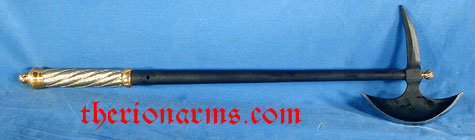
This is what the axe in the movie resembled. Notice the small head, which is designed to concentrate most of the impact in a small area. Which is great when you are trying to crack plate armor, but pretty much useless for most other applications.
The other inconsistency that stood out most to me was the insistence of carrying their swords slung over their backs in a baldric, Conan style. This just wasn't the case in those days.
Other inaccuracies for the sake of storytelling are reasonable. For example, I understand the use of the prehistoric Goddess statue as the Mac Guffin element. They needed an element of worship and Grendel's mother was part of the Epic, so that was a nice touch. That and all my neo-pagan friends got upset when they saw it, so it was also great for shock value alone. I remember being amused at hearing the low boos and hisses in the theater when I saw this for the first time while living in Seattle.
An online essay, "Living In Two Realities -The Obligations of Choreography" by F. Braun McAsh, a fight 20 year veteran choreographer, who used to work on the series "Highlander" summarizes it thusly;
The concept of theatricality and entertainment need not be antithetical to authenticity. Costume designers do their research; why should fight directors be immune to historical style? There is over 520 years of written text documenting Western European sword technique [Ed.'s Note, close to 800] and ample forensic evidence from which to extrapolate or infer. As film expands its venue to bring wider ranges of historical subjects to a demanding audience, fight choreographers (and directors) should ensure that history be represented at least as well in the depiction of the sword as it is in costume and sets.
I couldn't agree more, and I am hopeful that as these historical sources become more mainstream, the myth of the crude nature of martial arts in Europe fades.
One great example of progess in this area is with a recent movie, "Kingdom of Heaven," where the characters used techniques lifted straight out of Fiore Dei Liberi's famed fencing manual of c.1410, Flos Duellatorum ("The Flower of Battle"). This was another movie showing both Middle Eastern and European cultures fairly accurately, while still telling a good story.
On the whole it was a good movie, and a good book. Were I not such an aficionado for my western martial heritage, the points I've listed would have probably escaped my notice.
posted by mediavore at
6:25 PM


4 Comments:
I almost rented this movie a couple of times, but I was not aware of what the story was about.
I admit it, I wanted to see it because of Antonio ...and the fact that their was sword play. I love Highlander for that too!
Your review here was great. It will give me a lot to think about when I watch this movie, hopefully next week!!
ooh, please start your blog back up!
You said:The three shields duel was a nice touch, I've never heard of any judicial duels carried out this way from any time period, but it was still entertaining.
Not having seen the movie, I'm haven't seen the duel you talk about, of course. I do wonder, though, if it might have been a duel like that referenced in Kormac's Saga - it is quoted, among other places, in Ian Peirce's book Swords of the Viking Age. This is the wording of the translation in Peirce's book (if it will show up - otherwise see this for the quote):
A cloak was spread under their feet. Bersi said 'You Kormac, challenged me to Holmganga; but instead of it I offer you Einvigi. You are young and inexperienced, and at Holmganga there are difficult rules, but none whatever at Einvigi!' Kormac answered 'I shan't fight better at Einvigi, and i'll risk it, and be on equal footing with you in everything.' 'You shall have your way, then,' said Bersi.
This was the Holmganga law: that the cloak should be ten feet from one end to the other, with loops should be put pegs with a head at the top. These were called Tjosnur. Then three squares, their sides each a foot beyond the other, must be marked round the cloak. Outside the squares must be placed four poles called Hoslur (hazel poles). It was called a Hazelled Field when it was prepared thus. Each man must have three shields, and when these were made useless he must stand upon the cloak, even if he had moved out of it before, and defend himself with his weapons.
He who had been challenged must strike first. If either was wounded so that blood came upon the cloak he was not obliged to fight any longer. If either stepped with one of his feet outside the hazel poles he was held to have retreated; if he stepped outside with both feet he was held to have fled. One man was to hold the shield before each of the combatants. The one who received the most wounds was to pay a Holmslausn (indemnity for being released from the fight) of three marks of silver.
Thorgils held the shield for his brother, and Thord Arnidsaron that of Berso, who struck the first blow and cleft Kormac's shield. Kormac struck at Bersi in the same way. Each of them spoiled three shields for the other. Then Kormac had to strike; he struck, and Bersi parried with Hviting. Skofnung cut off its point, and it fell on Kormac's hand and wounded him in the thumb, whose joint was rent so that blood fell on the cloak. Thereupon the others intervened and did not want them to go on fighting. Kormac said, 'It's not much of a victory Bersi has got from my accident, though we part now.'
You, sir, are much more well-read in the topic than I would hope to be.
I prefer the mid to late reannaissance era of martial arts, especially the German schools.
That and their garb.
HAve you heard of a yahoo group for Western MArtial Arts? You might find it interesting. I've read threads on everything from Classical Greek to Wild West / 19th Century European/Western fighting styles. I remember even reading a thread on the very definition of "Western" Martial Arts.
They're the most polite group I've ever read. Scholars all.
Post a Comment
Subscribe to Post Comments [Atom]
<< Home